Influencer Marketing for Restaurants in Africa: What Actually Works in 2026
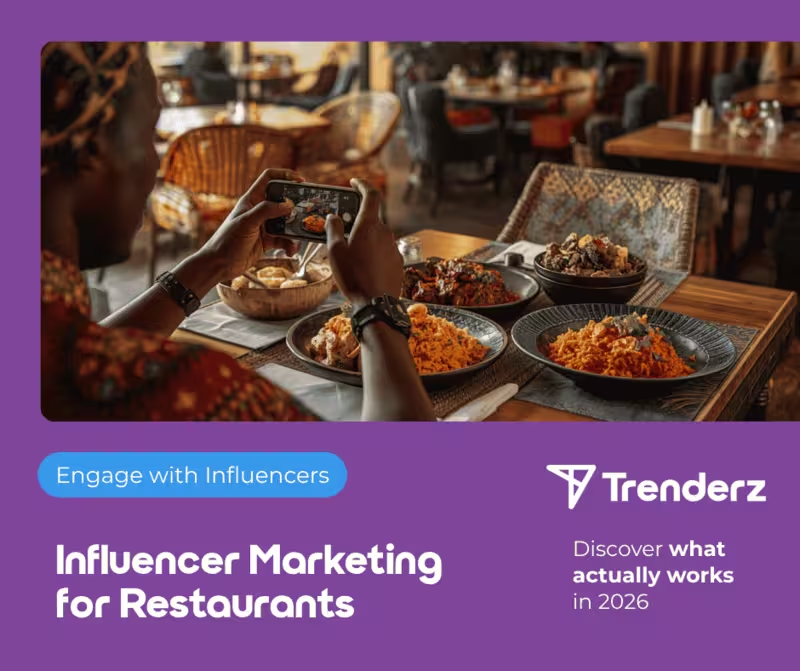
The hard truth about influencer marketing for African restaurants
If you run a restaurant in Abidjan, Dakar, Douala or any major African city, you've probably already tried influencer marketing. You invited a creator with a big following, offered a free meal, hoped for the best. Maybe it worked. Probably it didn't.
You're not alone. According to our analysis of 500+ restaurant campaigns at Trenderz, roughly 70% of first-time influencer campaigns fail to break even. Not because influencer marketing doesn't work for restaurants in Africa. It absolutely does. But because most restaurateurs apply the wrong playbook.
This guide explains what actually works in 2026 based on data from over 1 000 campaigns across 7 African countries, plus what to avoid.
Why traditional restaurant marketing is dying in Africa
In 2026, African urban consumers aged 25-40 have changed how they decide where to eat:
- 67% discover new restaurants through Instagram and TikTok, not Google or Yelp
- 54% will only try a new restaurant if at least one trusted source has recommended it
- 72% read at least 3 reviews or watch creator content before booking
- 61% book through Instagram DMs or WhatsApp, not traditional reservation systems
This means your Facebook ads, your Google Maps presence, even your beautiful website matter less than what creators say about you on social media. Whether you like it or not, content creators are now your most important marketing channel.
The 3 categories of restaurant campaigns that actually work
Category 1: Launch amplification
You're opening a new restaurant, or relaunching after renovation. Your goal is awareness and first reservations. The playbook: 5 to 8 micro and nano creators in your city, all visiting in the first 2 weeks of opening, each with a unique offer ("first 20 customers via this link get a free dessert"). Expected result: 60-150 reservations in the first month, plus brand recognition that compounds for 6+ months.
Category 2: Off-peak filling
Your weekends are full, but Monday through Wednesday are empty. The playbook: 2-3 micro creators specifically promoting a weekday-only offer (-25% Monday-Wednesday, special weekday menu). Expected result: 15-30 additional weekday reservations per month, with high margin since you're not cannibalizing peak.
Category 3: Brand positioning
You want to move upscale, attract a different clientele, or shift perception. The playbook: 1-2 carefully selected lifestyle creators whose audience matches your target positioning, with longer-form storytelling content (Reels, IGTV, blog mentions). Expected result: slower but durable shift in customer profile, premium pricing power.
How to spot the right restaurant influencer in Africa
The single biggest mistake African restaurateurs make is choosing creators based on follower count. A creator with 8 000 hyper-local engaged followers in Cocody will generate 5x more reservations than a creator with 150 000 followers spread across France, Côte d'Ivoire and Senegal.
The non-negotiable criteria for restaurant influencers:
- Audience geography: 60%+ must be in your city
- Engagement rate: above benchmark for their size (nano 5-12%, micro 3-6%, macro 1-3%)
- Content category: food and lifestyle, not random topics
- Collaboration frequency: max 8 restaurant collabs in last 90 days
- Quality of comments: real questions, not just emojis
On Trenderz, all these criteria are pre-verified and displayed on every creator profile. Outside Trenderz, you need to ask for Instagram Insights screenshots and manually verify.
The brief that turns a creator into a salesperson
A great influencer campaign requires a great brief. Most restaurateurs treat the brief casually ("come eat and post something nice"). This is why they get casual results.
A proper restaurant brief includes:
- Quantified business objective: "Generate 15 reservations over the 30 days following publication"
- Specific customer profile: not "young adults" but "professionals 28-40, dining budget 15-25 EUR per person"
- 3 to 5 mandatory differentiators: signature dish, view, terrace, special service, etc.
- Exclusive associated offer: "-20% for the creator's audience via this link"
- Precise deliverables: 3 stories, 1 Reel, 1 feed post, with deadlines
- Tracking mechanism: unique link and promo code
On Trenderz, this brief structure is built into the platform. Outside, you'll need to draft it manually for each campaign.
The economics that hospitality owners need to understand
Restaurant influence campaigns in Africa typically deliver these ROI ranges:
- Excellent campaign: ROI of 8x to 15x (revenue / cost of experience offered + commission)
- Good campaign: ROI of 4x to 7x
- Average campaign: ROI of 2x to 3x
- Failed campaign: ROI below 2x or negative
The difference between excellent and failed isn't budget. It's selection of creators + quality of brief + clarity of offer. You can have an excellent campaign with a 20 000 FCFA experience offered to a nano-creator. You can have a failed campaign with 500 000 FCFA spent on a macro celebrity.
The 4 mistakes that kill 70% of restaurant campaigns
Mistake 1: Picking the biggest follower count
As explained above, follower count is the worst predictor of conversion. Always check engagement, geography, content match first.
Mistake 2: No exclusive offer
If the creator's audience can book your restaurant via Google Maps or by walking in, they have no incentive to use the creator's link. Always create an exclusive offer that only works through the creator's channel.
Mistake 3: No tracking
If you can't measure which reservations came from which creator, you can't optimize. You're just hoping. Trenderz automates this. Outside Trenderz, unique promo codes are the minimum.
Mistake 4: One-shot mentality
One campaign per year won't transform your restaurant. The best results come from consistent presence: 2-3 micro creators every month, building a steady creator-driven booking pipeline. Treat it as a channel, not a campaign.
The Trenderz advantage for African restaurants
What Trenderz provides that traditional approaches don't:
- Pre-verified pool of 5 000+ creators across 7 African countries
- Audience analytics built into every profile (geography, engagement, content type)
- Automated tracking of reservations per creator
- Mobile Money payment integration
- French and English support in African time zones
- Performance-based pricing: 12% commission only on confirmed reservations, no upfront fees
For an independent restaurant in Africa, this changes the math. Instead of risking 200 000 FCFA on a single creator campaign that may or may not work, you start with zero financial risk and pay only when reservations actually arrive.
FAQ — Influencer marketing for African restaurants
How quickly do creator campaigns generate reservations?
First reservations typically arrive 5-10 days after publication. Peak between 2-4 weeks. Residual effects 2-3 months. Restaurant decisions are faster than hotels.
What's the minimum budget to start?
On Trenderz, zero fixed cost. You offer the experience (15 000-25 000 FCFA for a nano creator), and pay 12% only if reservations arrive. Real minimum budget: 20 000 FCFA + zero risk.
Should I focus on Instagram or TikTok creators?
For most African urban restaurants in 2026, Instagram still converts better for premium and mid-range dining. TikTok performs better for casual, viral, fast-casual concepts. Ideally work with multi-platform creators.
How many creators per campaign?
First campaign: 1-3 micro creators. Established restaurants doing monthly campaigns: 2-3 micro per month, plus 1 macro every quarter for reach.
What if a creator doesn't deliver on the brief?
On Trenderz, you can flag non-compliance from your dashboard. Commission is paused while we mediate. This safety net doesn't exist with direct DM arrangements.
Get started
Register your restaurant on Trenderz for free and access 5 000+ pre-verified creators. No fixed fees, no commitment, performance-only pricing.
Read more:


.webp)
.svg)

